
Tallinn’s #1 car interior cleaning company
Headlight polishing
Auto Sisepuhastus restores cloudy, yellowed headlights for cars from Tallinn and Harju County at our Mustamäe workshop. This polishing service differs from paint correction: we sand the polycarbonate lens and finish with a new UV protective coating.
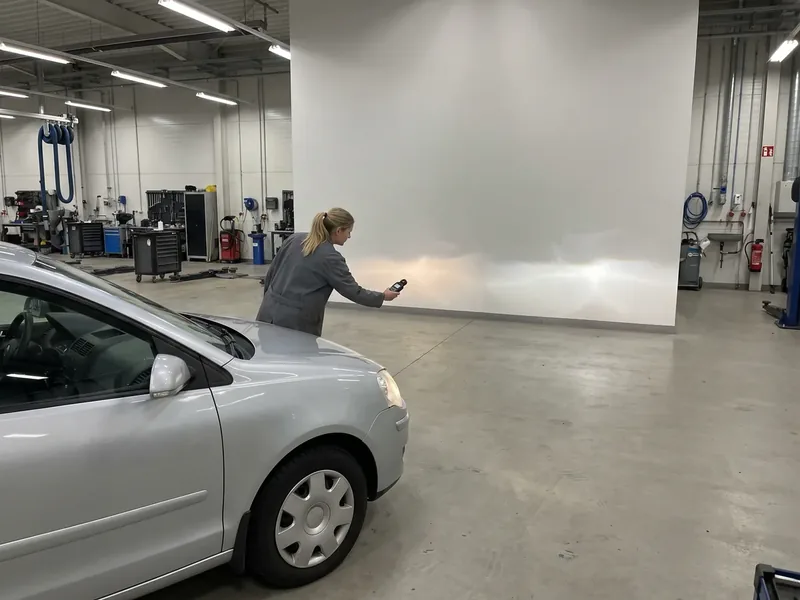
We measure low-beam brightness on a wall 10 metres away before and after polishing and record both lux readings on the job sheet. Across the 633 cars whose headlights we had polished by the end of 2025, the average reading at 10 metres rose from 79 to 131 lux.
- Licensed and insured
- 100% satisfaction guarantee
- The average reading increased from 79 lux to 131 lux
Book an appointment
When do headlights need polishing?
Yellowish Blur on the Surface of the headlight
The clearest sign is a yellowish or milky layer on the outer surface of the headlight, which can also be felt with a finger: intact polycarbonate is smooth as glass, and the oxidised surface is rough. The light from a flashlight is spread over such a surface in a wide spot, while it is reflected as a sharp glow from the surface of a clear headlight.
Light Beam Upper Limit Scatters
Park the car at a distance of 5 meters from the wall of the garage or house and turn on the dipped beam: the light beam of a full headlight has a clear upper horizontal border, the border of a cloudy headlight is blurred and part of the light goes to the top of the wall. This diffused light dazzles oncoming traffic and leaves the road less illuminated, especially in rainy weather, when the wet asphalt absorbs the light anyway.
MOT Note About Headlights
During the technical inspection, the condition of the headlights and the adjustment of the dipped beam are checked, and the inspector records the found deficiency on the inspection card. We polish the lamps of the car with the headlight note before the re-inspection, because the 76-euro polishing is cheaper than replacing one new lamp.
Why Polycarbonate Turns Yellow
Today's headlight lenses are made of polycarbonate, which is impact-resistant and lightweight, and breaks down when exposed to UV rays. The factory covers the headlight with a thin UV hard coating, which the sun, wash brushes and winter sand wears away over the years, and the top layer of polycarbonate that has lost the coating oxidizes to yellow and becomes cloudy with microcracks.
In Estonia, wear is accelerated by the opposite load of the two seasons: on the summer solstice, the day in Tallinn lasts 18 hours and 40 minutes, and the surface of the headlight receives a lot of UV radiation, in winter, salt and sand splashes from the road, which scratches the already weakened surface. The heat from the halogen bulb heats the lamp from the inside, so oxidation proceeds faster on a warm surface than on a cold body panel.
How headlight polishing works
Masking and Wet Sanding
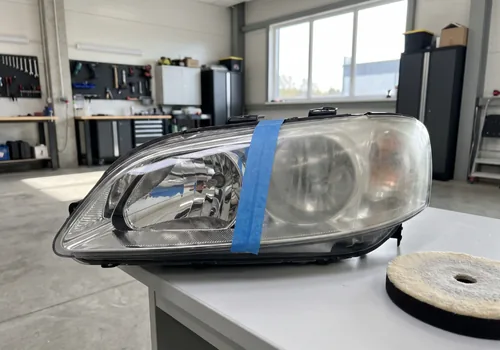
The area around the headlight is covered with two layers of masking tape, because the sandpaper slides easily on the painted surface on the edge. We then wet-sand the headlight with three consecutive papers, 1200, 2000 and 3000 grit, and with each new paper we switch the sanding direction diagonally so that the traces of the previous step are visible and disappear completely before the next step.
Machine polishing with a Soft Pad
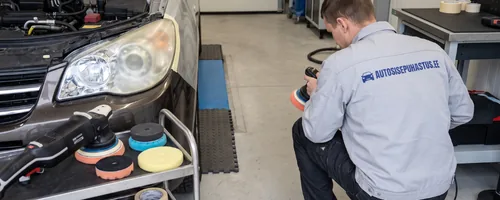
After the third level of sanding, the headlight is uniformly matt and its transparency is restored by an orbital polisher with a 75 mm foam pad and fine-cutting paste. We work at a low speed and in short sections, because polycarbonate softens already at 140 degrees and the overheated surface remains wavy.
Application of UV coating and Light Measurement
A UV-resistant transparent coating is applied to the polished and degreased surface with isopropanol in one even pass, because the second pass leaves streaks on the liquid layer. The layer is dry to the touch in 15 minutes, after which we measure the light intensity of the low light with a lux meter from the same 10-meter distance as before the work and write the result on the job sheet.
Call us:
- Licensed and insured
- 100% satisfaction guarantee
Tallinn's Dark Season and Winter Road Sand
On the winter solstice, the day in Tallinn lasts 6 hours and the commuter drives in the dark both in the morning and in the evening, so the clarity of the headlights is more a matter of safety than appearance. In winter, the surface of the headlight is covered with salt and sand splashed from the road, which is rubbed along the surface by the brushes of the automatic car wash, therefore Auto Sisepuhastus recommends washing polished headlights by hand with a soft sponge, and the coating of the headlights will be checked free of charge after the winter season on a car that has come to the workshop for other work.
Headlight Polishing Price and Time
Polishing a pair of headlights starts at €76; one headlight starts at €38. A pair takes 75 minutes: 10 for masking, 30 for three-stage wet sanding, 20 for machine polishing and 15 for UV coating. One headlight takes 40 minutes. By the end of 2025, we had completed 633 headlight jobs: 576 pairs and 57 single headlights. We polished headlights on 94 cars in 2025. The car can be driven in rain after one hour and taken through a car wash after seven days, once the coating has cured.
Polishing one headlight before a reinspection near Tallinn Kristiine Gymnasium
Car owner: Inge T., whose car was waiting for a re-inspection. Where did the car come from: Near Kristiine High School in Tallinn, Kristiine.
1. Measuring the light intensity before work: the lux meter measured the light intensity of both low beams at a distance of 10 meters on the wall, and the heat gun showed that the haze of the old lamp is on the outside, not inside the lamp.
2. Masking and wet sanding: The area around the headlight was covered with two layers of masking tape and the headlight was wet sanded in three stages, with P1200, P2000 and P3000 paper, each new paper perpendicular to the previous sanding direction.
3. Machine polishing with a soft pad: An orbital polisher with a 75mm foam pad and fine cutting paste worked in short cuts at low rpm because the polycarbonate softens at 140 degrees.
4. Applying the UV coating and measuring the light: one even coat of the UV-resistant coating was applied to the lamp degreased with isopropanol, the layer was dry to the touch in 15 minutes, and a new lux reading from the same distance of 10 meters went on the job sheet.
Cost: Polishing of one headlight: 1 × €38; car drop-off at the Mustamäe workshop: 1 × 0 €. The total amount of job sheet No. 11,942 including VAT is €38.
Project time in 2024: 40 minutes of work and Inge was waiting for the car to be completed in the customer area of the workshop. The car was allowed to go into the rain 1 hour after work and to the car wash after 7 days.
What changed: The low beam reading of the polished headlight increased from 84 lux to 139 lux at a distance of 10 meters, and the reading of the new headlight was 142 lux on the same wall.
Frequently asked questions
Does Polishing Help If Moisture Is Inside The headlight?
No. Water droplets or fog on the inside of the headlight means a blown gasket or cracked housing, and polishing the exterior won't fix it. We check it before work with a hot air gun: the haze of the outer surface does not change when heated, and the internal condensate dissipates in front of the eyes.
How Long Do Polished Headlights Stay Clear?
A lamp polished with a UV protection layer stays clear for 3 years, because the layer takes on the load of the sun and washing brushes that the factory coating used to carry. Polished bare polycarbonate without a coating will become cloudy again in 6 months, so don't Auto Sisepuhastus never polish headlights without a coating.
Can Only One headlight Be Polished?
Yes, on a car with one replaced and one old lamp, we only polish the old lamp, which costs from 38 euros and takes 40 minutes. We compare both lights with a lux meter, because next to the new lamp, the old lamp, apparently in good condition, gives off significantly less light.
How Many Times Can a headlight Be Polished?
Each sanding removes a thin layer of polycarbonate from the surface of the headlight, therefore the same headlight can be fully sanded and polished 4 times. For a previously sanded headlight with deep cracks, we recommend a new headlight instead of polishing, because the cracked plastic will continue to crack in the cold.
Contact us
For a quicker reply, call +372 XXXX XXXX, tell us the make and year of the car and whether the fog is on the lamp or inside, and we will offer you the first available appointment at the Mustamäe workshop.